
Key Takeaways
• User acquisition alone isn’t enough to build a lasting service marketplace.
• Long-term success comes from turning one-time transactions into ongoing relationships.
• Marketplaces that control the entire user lifecycle—payments, personalization, community, and post-purchase engagement—see higher retention.
• Differentiation goes beyond features; real advantage comes from strong networks, exclusive data, and domain expertise.
• When a marketplace evolves into a platform users depend on, it moves from being transactional to becoming a lifestyle companion—driving sustainable growth.
Why Service Marketplaces Must Evolve Beyond Acquisition
Most consumer-facing service marketplace apps start the same way:
you spend months refining the front-end experience, running campaigns to acquire users, and onboarding providers.
You get the first few thousand sign-ups, maybe even a decent transaction volume.
But here’s the reality: in many cases, the journey stops right there.
The user books the service, completes the transaction, and drifts away.
The provider delivers their service but doesn’t get pulled into a longer relationship with the platform.
The gap isn’t in technology, it’s in what happens after the first interaction.
The opportunity?
To turn that one-off transaction into a living, breathing ecosystem where customers and providers stick, grow, and keep coming back.
An ecosystem where the app is not just a tool to find a service, but the central place to experience it, track progress, connect with others, and discover more value over time.
One App to Anchor the Entire Experience
A true marketplace ecosystem doesn’t live only at the point of purchase.
It has to own the full lifecycle from first click to long-term retention.
That starts with control over the transaction flow.
If payments run through scattered third parties, you lose both the user relationship and valuable data.
When the wallet lives inside the app, you gain flexibility loyalty credits, bundled offers, subscription models, or even peer-to-peer transfers within the community.
Then comes community integration.
Imagine a user who books a local coach for pickleball.
In a transactional model, the story ends there.
In an ecosystem model, that booking unlocks invitations to local tournaments, group sessions, and skill challenges all coordinated within the platform.
Layer in AI-driven personalization and the value grows exponentially.
If a user sets a goal (“I want to improve my game in three months” or “I want to lose 5 kg”), the system can learn from thousands of similar users, identify patterns in what worked for them, and adjust the recommendations in real time.
And importantly treat the app as a post-purchase engine.
Acquisition is just the start; the real win is when the user stays engaged, refers friends, and finds so much value that leaving the ecosystem feels like a loss.
What Competitors Can’t Easily Copy
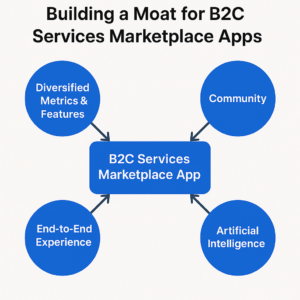
Most app features can be cloned.
Your payment interface, chat function, even AI recommendation logic a well-funded competitor can replicate those.
The true moat lies elsewhere.
Network strength is one example.
If you’ve spent years building relationships with thousands of verified providers across multiple regions, that’s not something a new entrant can recreate overnight.
It’s not just a directory, it’s trust, contracts, and operational readiness.
Then there are exclusive data assets.
Over time, a marketplace collects valuable insights, audience profiles, provider performance scores, engagement patterns by region or demographic.
Handled ethically, this data becomes a foundation for personalization, targeted offers, and operational efficiency.
And in specialized categories, whether it’s sports coaching, music lessons, or wellness services, domain-specific performance metrics set you apart.
Instead of generic measures like “hours booked” or “calories burned,” you can track progress that actually matters to the category:
sprint speed for athletes, vocal range improvement for singers, posture stability for yoga practitioners.
That’s where you stop being “another marketplace” and start being the destination for your niche.
From First Touch to Retention Loop
To deliver this vision, the user journey needs to be mapped end-to-end.
It begins with the web funnel.
Before a user downloads the app, they should already be experiencing your value, browsing providers, booking trials, reading curated content, or joining waitlists.
From there, the handover to the app should be seamless.
The app takes over as the space where the service is delivered, progress is tracked, and community engagement happens.
For the supply side, a dual-app setup (or at least dual-mode access) ensures providers have their own tailored experience, schedule management, earnings tracking, client communication; without cluttering the customer-facing interface.
Within the app, community spaces create retention hooks.
Event boards, group chats, and challenge leaderboards all help turn isolated users into active members.
Finally, the marketplace layer expands monetization beyond the core service:
equipment sales, exclusive workshops, or partner offers that feel native to the user’s journey.
Technology & Integration Strategy
The tech stack doesn’t have to be exotic, but it has to be intentional.
Algorithm development is central.
In a sports scenario, for example, this means building models that can connect specific activity data (training frequency, performance metrics) to desired outcomes.
That’s how you generate recommendations that feel personalized, not generic.
Platform integrations solve the adoption challenge.
Instead of asking users to adopt yet another tracking app, push relevant data into platforms they already use Apple Health, Google Fit, Strava.
You still own the relationship, but you meet them where they are.
At scale, AI insights can surface trends that aren’t obvious at the individual level:
“Users in coastal regions progress 15% faster in swimming programs,” or
“Weekend group bookings have 25% higher retention than weekday solos.”
All of this requires secure data handling not just for compliance, but to build trust.
The more data you collect, the more you have to prove you deserve it.
Monetization & Business Metrics
A robust B2C services marketplace rarely survives on a single revenue stream.
Diversification is the safety net.
The most common levers include:
- Subscriptions (premium community access, unlimited bookings)
- Per-transaction fees (standard marketplace model)
- Event ticketing (competitions, workshops, meetups)
- In-app purchases (equipment, training plans, digital resources)
- Corporate packages (bulk services for employee wellness programs)
Balancing CAC (customer acquisition cost) and LTV (lifetime value) is key.
Even sharing a simple metric like “$20 to acquire a user, $150 earned over six months” without revealing exact acquisition channels can signal efficiency and growth potential to partners or investors.
Upselling and cross-selling inside the marketplace keep LTV climbing without proportional CAC increases.
Scaling from Niche to Broad Ecosystem
Phase 1 – Foundation
- Solidify onboarding flow
- Integrate payments natively
- Launch basic community features
Phase 2 – Personalization
- Deploy AI-driven recommendations
- Add domain-specific metrics tracking
- Integrate with existing user platforms (e.g., fitness or productivity trackers)
Phase 3 – Marketplace Expansion
- Introduce in-app store for related products and services
- Launch targeted offers based on user profile and activity history
- Build out event/tournament/workshop infrastructure
Phase 4 – Regional Scaling
- Expand provider network into new geographies
- Localize community and marketplace content
- Introduce regional challenges and competitions to spark adoption
Positioning for Partners & Investors
A well-built services marketplace has more than user numbers to offer.
The combination of network density and exclusive data creates a defensible position in a competitive space.
Early dominance in a specific vertical (like sports, wellness, or creative skills) gives you leverage to scale horizontally into adjacent categories.
For partners, this means access to a pre-engaged audience that’s already segmented and primed for relevant offers.
For investors, it’s proof of a repeatable growth model anchored in retention, not just acquisition.
From Single Interaction to Lifestyle Integration
The most powerful marketplaces aren’t the ones with the flashiest acquisition campaigns,
they’re the ones that quietly become part of their users’ lives.
When your app becomes the default place a customer goes to book, track, connect, and grow, you’ve moved beyond being a tool.
You’ve become a lifestyle companion.
And that’s when you stop worrying about the next transaction…
because your ecosystem is designed to make the next one inevitable.