

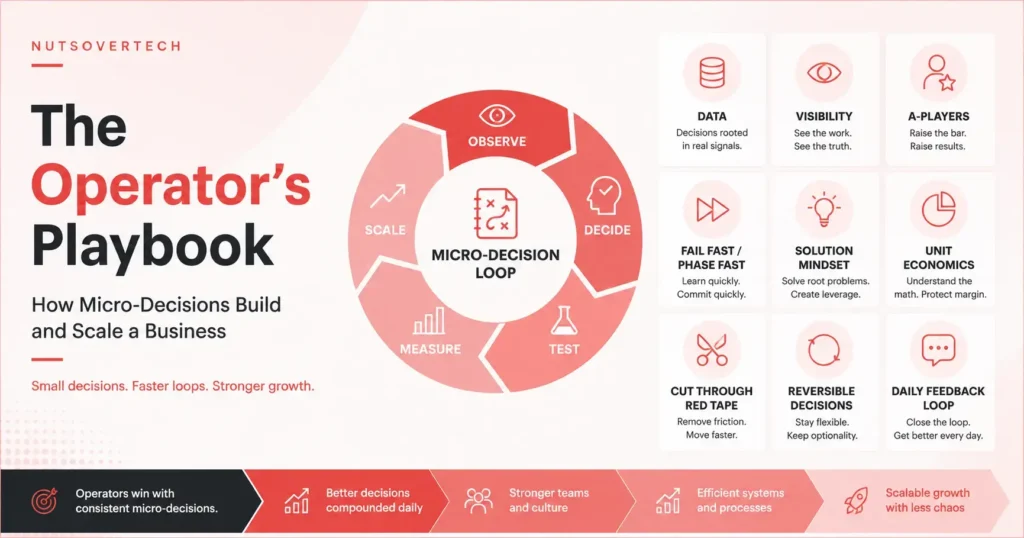
The micro-decisions that shape your business every day don’t come from board meetings or strategic consulting firms. They come from an operator’s instinct to make things work and keep momentum moving.
Whether you’re navigating a tough quarter or pushing for the next phase of growth, a true operator thrives on the frontline. Where most people hesitate, an operator with great instincts and resilience steps up with these micro-decisions—knowing full well they may or may not work. However, not taking any decisions isn’t an option if you want to keep building.
While there isn’t a one-size-fits-all approach to such decisions that lifts your business, there are always frameworks that can help arrive at them. Even before getting to such frameworks, a few considerations are must-haves and non-negotiable:
1. Data: You Can’t Control What You Can’t Measure
You absolutely need a way to track everything that moves the meter for your business—all leading and lagging indicators. Leading with lagging indicators alone, though, is a sure recipe for disaster! An “I need results, not excuses” type of manager almost always gets stuff worse than excuses—that’s a boatload of crap!
Lagging indicators are just a cue to look at what leading indicators are falling behind. Also, ensuring you are always looking at one variable at a time has to be the rule of thumb for every decision-making process.
2. Visibility: Blending Hard Data with Ground Reality
Visibility is an extension of data. Data, however, only objectively points at certain things, leaving subjective realities behind. That’s where ensuring visibility becomes a combination of both subjective and objective data. You need to know not just that a conversion metric moved, but how the team and customers feel on the ground when it happens.
Thanks to AI—sentiment analysis, insights, and rule-based trackers of progress—filtering signal from noise has become a lot easier than in the past. Features like “Catch Up” in Slack, for example, make skimming through ground-level sentiment handy without getting bogged down in operational clutter.
3. A-Players: Finding Your Dark Horses
Performers aren’t always the loudest, but they are deepest with their insights on what might work. A true operator knows how to call a bluff and knows his dark horses. If you have none or you haven’t identified one yet—probably you need training on it 🙂
4. Fail Fast, Phase Fast: Removing the Fear of Failure
If failure scares you, I have advice for you: go home! Fear of failure almost always blocks most micro-decisions from being taken and executed. Hell, it blinds you so much you can’t even think of the right options.
You need a process where your team executes these decisions fast and has reliable reference points to judge success, failure, or at least directional evidence of things going in the right direction. But there’s a distinct dual edge here: failing fast means killing dead-end bets early, and phasing fast means rolling out micro-decisions in small, low-risk stages rather than high-stakes rebrands. Knowing failure will be a result for most such decisions—and planning phased rollouts ahead of time to contain the splash damage—is a mature operator signature.
5. Solution Mindset: Action Over Complaint
If you love complaints coming to you and hate living with them—you are the leader in the right place. Complaints from A-players are often signs of a team trying but unable to get around the blockers. Complaints from everyone else are generally noise, and a smart operator knows how to crush them.
However, once acknowledged, the solution mindset almost always yearns for action. Tries multiple things, tracks everything, and follows through with pivots wherever necessary! But the key is leading with SOME solution, not complaints.
6. Wisdom Comes from the Most Unexpected Places
Sometimes the answer is in your past, sometimes it’s right below your nose, and sometimes it’s in deep research, including talking to experts and mentors. You really need to look in every nook and corner to find where a good candidate decision lives!
7. Unit Economics Over Top-Line (Protecting Cash & Margin)
In everyday operations, not all revenue is created equal. Chasing vanity top-line growth while eating into margins is a bad trade. Evaluate every micro-decision on its immediate effect on unit economics and gross margin, not just volume. Cutting a high-friction, low-margin process that saves $2,000 a month builds the exact same bottom-line strength as closing a new client—with 100% certainty and zero acquisition cost.
8. Cutting Through Red Tape
Approvals and hierarchy are important, no doubt, but too much of it and momentum just dies. Structure is good for stability, but if every small decision has to pass through five people, you have already lost the race. A real operator gives themselves and their A-players the freedom to skip layers and run quick experiments directly with the frontline, even if it’s for 24 hours only. If a micro-decision is taking three days to get a yes, it’s not a micro-decision anymore—it has become a process problem.
9. Not Every Door Needs the Same Amount of Thinking
Most people get stuck because they treat every decision like it’s permanent. Truth is, most micro-decisions—changing a line in your outreach message, testing where a button sits, tweaking your pitch—these are doors you can walk back through if it doesn’t work. So move fast on those, don’t overthink. Save your real deliberation for the rare decisions that actually have legal or brand risk attached, those are the ones where slowing down makes sense.
10. Make the Feedback Loop Daily, Not Weekly
Weekly reviews are fine for keeping the lights on, but if you’re trying to grow through daily bets, one week is too long to wait and find out. Bring your check-ins down to a daily habit—quick, five-minute pulse checks work better than long sprint reviews here. Every evening just look at what you tried that day, what moved (even a little), and decide if tomorrow you push harder or change direction. Do this daily and you’ll learn more in a week than most teams learn in a month.
Conclusion
Building a sustainable business doesn’t hinge on a single silver bullet or a strategic deck built for a board meeting. It hinges on the compounding velocity of your daily choices. By pairing cold data with ground-level visibility, empowering quiet top performers, and executing fast with zero hesitation, you turn continuous experimentation into sustainable growth.
Making micro-decisions on the fly requires comfort with ambiguity, and some of them won’t hit the target. But in the hands of a true operator, taking calculated, daily action will always beat sitting still and waiting for the market to move for you. Execute, learn, adapt, and keep moving the needle.